How long will this hike actually take? It is the first question every group asks, and the one leaders most often get wrong. Distance alone is a poor guide. A short walk with a big climb can take twice as long as the kilometres suggest.
There is a classic rule for working it out, and this guide shows how to use it properly for a real group, with a worked example from my Adventurous Journey Planning Handbook. I have relied on it through about 15 years as a Scout leader in the Blue Mountains, and over 40 years of Scouting.
 5:51
What Is Naismith's Rule?
Naismith's rule is the standard way to estimate walking time in the bush. Allow 1 hour for every 5 km of distance, plus 1 hour for every 600 m of climbing.
That gives the Naismith time: the minimum for a fit adult, without a heavy pack, walking efficiently. Real groups are slower, so the rule is a starting point, not the answer.
How to Use It for Your Group
For each leg of the walk, note the distance in kilometres and the total climb in metres. Then:
- Divide the distance by 5 to get hours.
- Divide the climb by 600 to get hours.
- Add them together for the raw Naismith time.
- Add a group buffer of 10 to 30 percent, for age, fitness, pack weight and rough ground.
On a leg with more than 300 m of descent, add about half its equivalent climbing time as well. Steep descents are slow too.
A Worked Example
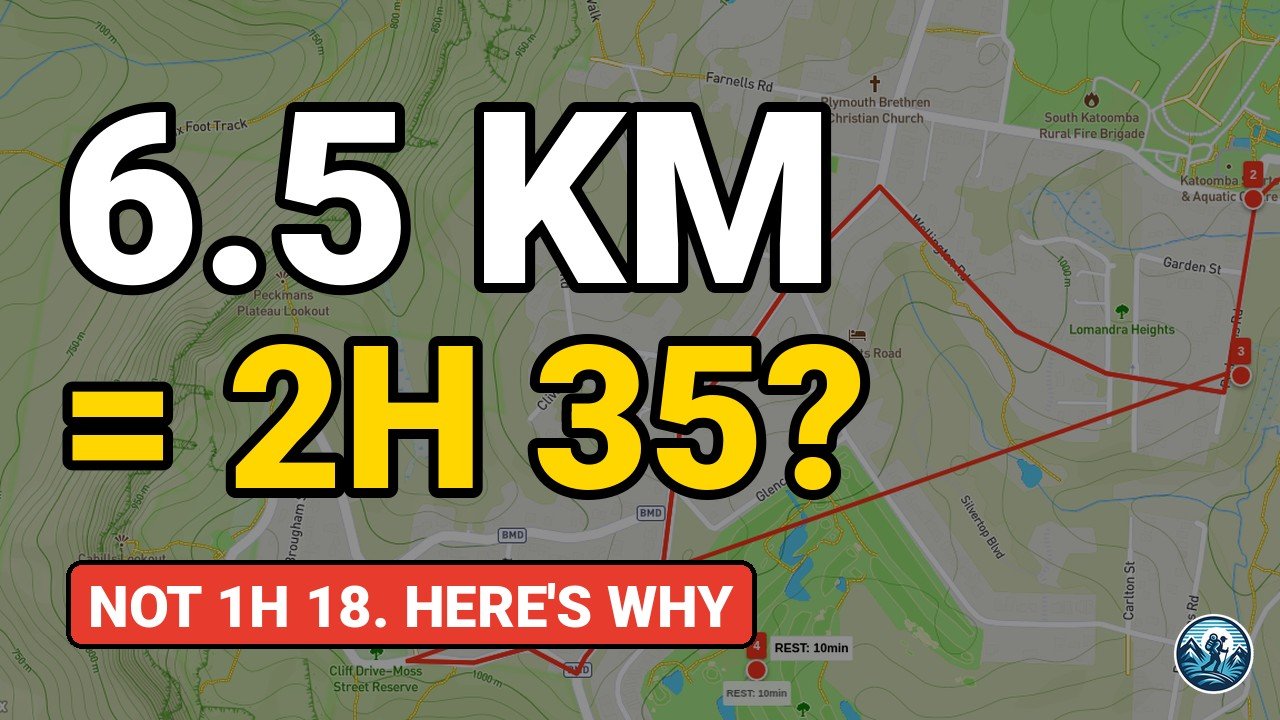
Here is the example from the handbook: a leg from a saddle, over a ridge and down to a campsite. It is 6.5 km long, with 200 m of climbing and 630 m of descent.
- Distance: 6.5 ÷ 5 = 1.3 hours.
- Climb: 200 ÷ 600 = about a third of an hour.
- Descent: 630 m is significant, so add about half an hour.
- Raw time: about 2 hours 10 minutes.
- With a 20 percent group buffer: about 2 hours 35 minutes.
Distance alone would suggest a bit over an hour. Plan on about twice that.
Break the Walk Into Legs
Timings only work if you break the walk into legs between meaningful waypoints: a saddle, a water source, a junction or a campsite. Points you will actually navigate to. For each leg, record:
- The start and end grid references.
- The distance along the path.
- The total ascent and descent.
- The time, and any hazards.
Measure distance along the path with string or a map wheel. On bush terrain the real distance is often 15 to 30 percent longer than a straight line. For the climb, count the contour lines you cross going uphill and multiply by the contour interval, then do the same downhill. If contours are new to you, how to read a topographic map explains them, and how to read a 6-figure grid reference covers the start and end points.
Up and then down doesn't cancel out. Climbing costs time and energy. Descending costs legs and concentration.
How Far Should a Group Walk in a Day?
Size each day for the least capable person in the group, not the fittest. As a starting point:
- Beginners: 8 to 12 km a day.
- Intermediate walkers: 12 to 18 km a day.
- Experienced walkers: 18 to 25 km a day.
And remember that 10 km with 800 m of climbing is far harder than 15 km on the flat. How to pace a group walk covers keeping everyone together once you are moving.
 33 sec
Timing Gates and a Turnaround Time
Leg times let you set timing gates: the expected arrival time at each waypoint. They are decision points, not targets. When you reach a gate:
- On time or ahead: note it and carry on. Don't speed up. Banking time early often means burning it later.
- Up to 20 percent behind: carry on with awareness, trim the rest stops, and watch the next gate closely.
- More than 20 percent behind, or behind on a difficult leg: stop and make a conscious decision to carry on, shorten the walk or turn around.
Then set a turnaround time each day by working backwards from last light, not forwards from the start. Take the walking time from where you are to camp, add at least 30 minutes to set up, and subtract that from last light.
Decide in advance that it is non-negotiable. At the gate you are carrying out a decision, not making one. Write the gates into your plan and brief the group before you leave. When to turn around goes deeper on making that call in the field.
Let the Planner Do the Maths
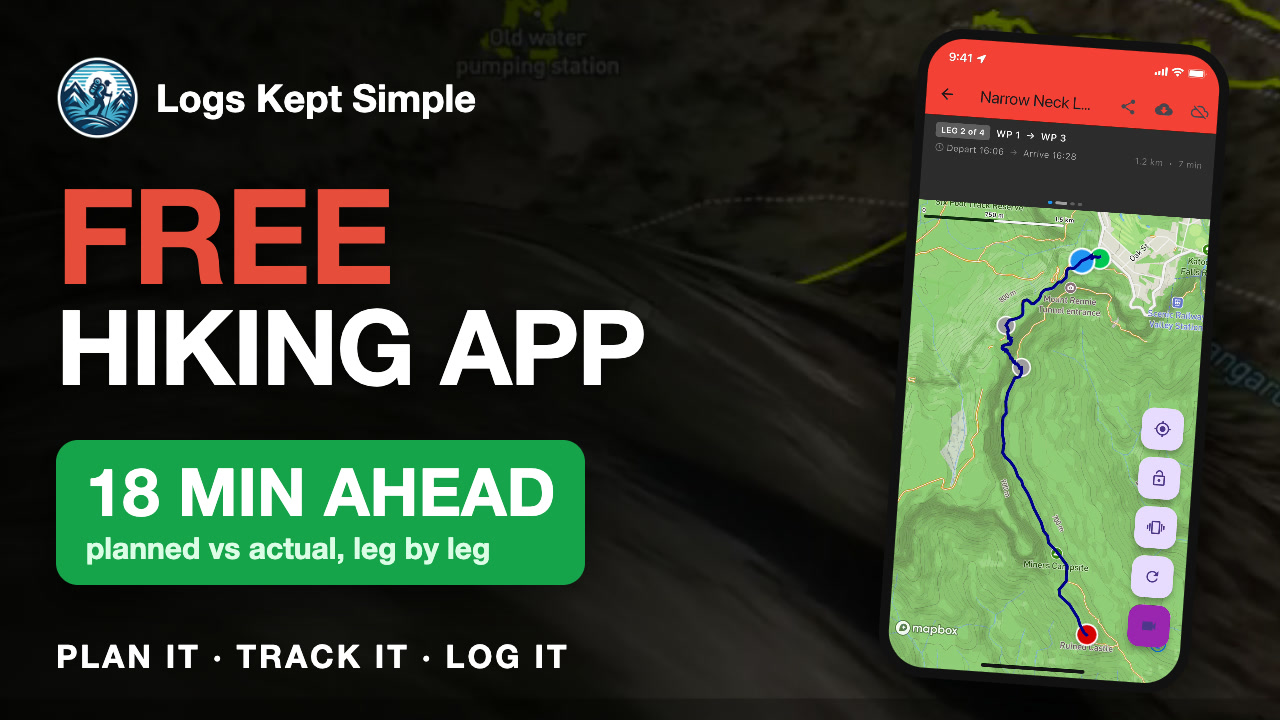
Doing this by hand is a skill every leader should have. Once you can, the free planner in Logs Kept Simple will do the arithmetic for you:
- Fill in the activity type, a name, who prepared it and the start time, then continue to the map.
- Zoom to your area and click your first point, then the next. It can follow paths, or switch to straight lines for off-track legs.
- Open the waypoints table. Each leg already has its grid reference, map sheet, heading, elevation gain and loss, and distance.
- Set the track conditions for each leg, from an easy vehicle track to thick bush. Don't leave them on the default, or the timings won't be accurate.
- Add rest time at waypoints. The summary shows activity time, total time and your end time.
The planner combines distance, climb, descent and track conditions to work out each leg's time in minutes. For example, 320 m of medium going with a little up and down comes out at 11 minutes. On a multi-day trip, Next Day closes the day with a campsite and starts the next.
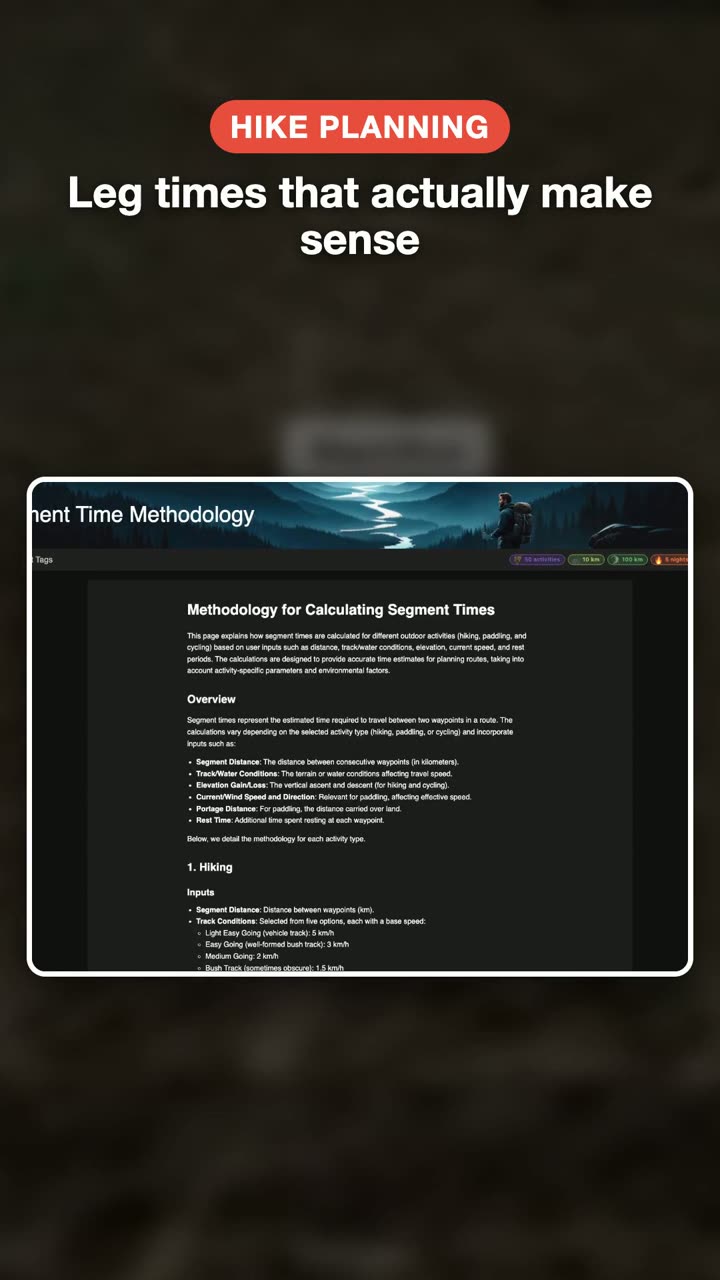
Save it and download a PDF with the leg table, a daily summary, an elevation profile and maps. The bearings in the PDF are magnetic, already adjusted for the declination in your area, ready for a standard compass. The method is published on the site's Segment Time Methodology page, so you can see exactly how it is worked out. It is a planning estimate. Your group, the weather and the ground on the day still make the call.
Frequently Asked Questions
What is Naismith's rule?
Allow 1 hour for every 5 km of distance, plus 1 hour for every 600 m of climbing. It gives the minimum time for a fit adult without a heavy pack.
How much extra time should I add for a group?
Add a buffer of 10 to 30 percent for age, fitness, pack weight and rough ground, plus about half the equivalent climbing time on a leg with more than 300 m of descent.
Does descent count?
Yes. Up and then down doesn't cancel out, and steep descents are slow. Count the downhill contour lines too.
How do I set a turnaround time?
Work backwards from last light: take the walking time to camp, add at least 30 minutes to set up, and subtract the total from last light.